







Seventy percent of kids in middle- and low-income nations are not able to read and comprehend an easy story, following COVID panic lockdowns that closed schools worldwide, according to a brand-new report from the World Bank.
“The State of Global Learning Poverty: 2022 Update” is a joint publication of the World Bank, UNICEF, FCDO, USAID, and the Bill & Melinda Gates Foundation which keeps in mind that even prior to the COVID-19 pandemic, almost 6 out of every 10 ten-year-olds in low- and middle-income nations were struggling with discovering hardship.
The worldwide reaction to the pandemic between February 2020 and February 2022 resulted in education systems that were totally closed for in-person knowing for about 141 days. In parts of Asia, Latin America, and the Caribbean, kids lost approximately 273 complete days of school.
“Evidence is accumulating that the capacity of these remote learning efforts to substitute for in-person learning is very low. As a result, in many countries the school closures led to large learning losses,” according to the report. “This is true even in countries with high internet penetration and higher levels of digital skills among the teaching force.”
The only sections of the population who aren’t seeing decreases in instructional efficiency are “richer” homes, which use broader dependable internet connection, access to gadgets, a location to study, availability of books and learning materials, and a favorable home environment.
“COVID-19 has devastated learning around the world, dramatically increasing the number of children living in Learning Poverty,” said Jaime Saavedra, Global Director for Education at the World Bank. “With 7 in 10 of today’s 10-year-olds in low- and middle-income countries now unable to read a simple text, political leaders and society must swiftly move to recover this generation’s future by ensuring learning recovery strategies and investments.”
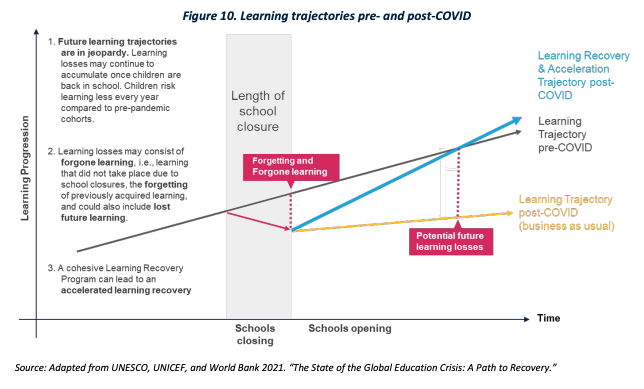
Some of the data is based upon modeling, however emerging information determining real knowing levels of kids in resumed schools is substantiating the forecasts of big knowing losses.
The report also warns of a “major shock to human capital accumulation and productivity” because of the loss of fundamental knowledge. Once they go into the labor force, the failure of children to read or show standard proficiency in other skills might minimize their future performance and their earnings. In one example, the report noted that after a dry spell in Zimbabwe decreased education back in the 1980s, children who were affected saw their lifetime incomes decrease by 14 percent.
The World Bank report states that without action to increase kids’s efficiency in standard abilities like reading, the existing generation of trainees run the risk of losing $21 trillion in life time profits– the equivalent of 17 percent of the current worldwide GDP.
“The report shows what we feared,” said Alicia Herbert OBE, Director Education, Gender, Equality and Gender Envoy at Foreign Commonwealth Development Office (FCDO). “Even fewer children are now able to access a quality education, due to the impact of COVID-19 and school closures globally, especially the most marginalised.”
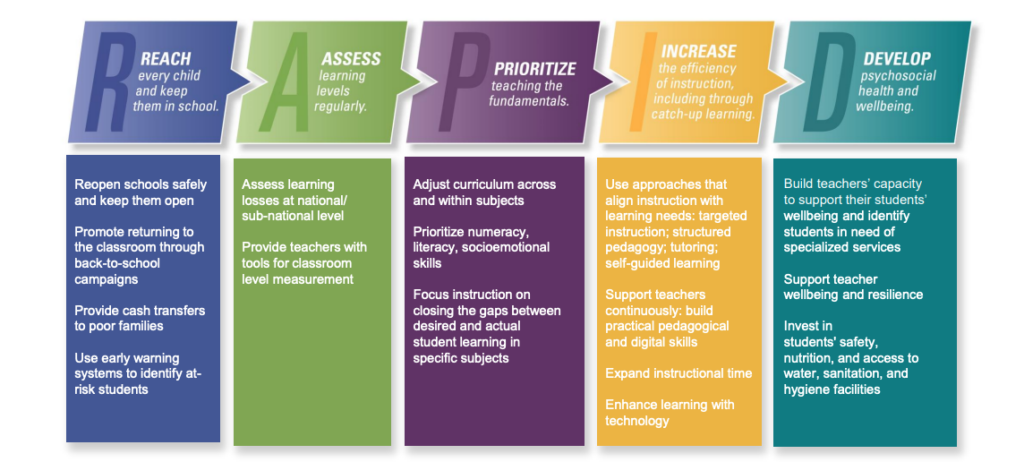
Authorities approximate that more than 1.6 billion kids in 188 nations suffered pandemic-related school closures. The World Bank has actually offered a brand-new RAPID Framework to assist speed up the education of children who have actually been affected by school closures.
- Reach every child and keep them in school
- Assess learning levels regularly
- Prioritize teaching the fundamentals
- Increase the efficiency of instruction, including through catch-up learning
- Develop psychosocial health and well-being
The World Bank, UNICEF, FCDO, USAID, and the Bill & Melinda Gates Foundation have partnered on this effort and want to highlight the requirement for nations to act urgently and decisively on assisting kids get fundamental abilities.
“Getting children back into the classroom is just the first step – but if we stop there, we will rob millions of children of the chance to reach their full potential. Every child has a right not only to be in school, but to learn in school, acquiring the basic skills that are the foundation for higher learning and higher income levels someday – in turn supporting equitable development and sustainable growth,” said Robert Jenkins, UNICEF Global Director of Education. “We can’t let children’s learning become yet another casualty of the COVID-19 pandemic.”
H/T Timcast


